
AI visibility is not a single score
Direct citations, unlinked brand mentions, first-party source share, third-party source share and source density are different outcomes, and they behave differently on every AI surface. Treating them as one number hides where you are actually winning or losing.
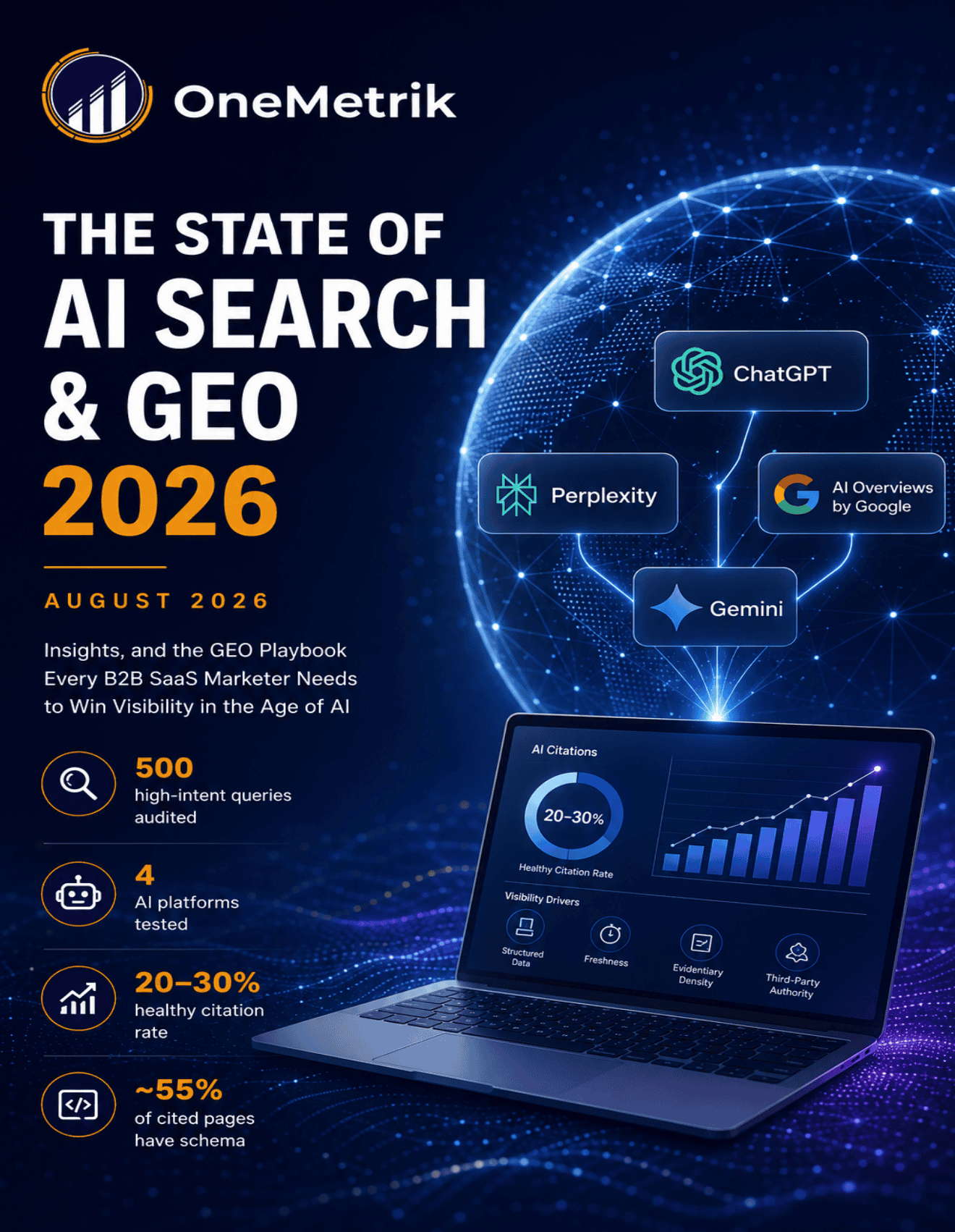
This report is a directional audit, not a league table. It measures citation and mention behaviour across four access paths, cross-references every cited page against Ahrefs and a technical crawl, and pairs the findings with a survey of how B2B SaaS marketing leaders are budgeting for and monitoring AI visibility today. The findings are descriptive: they describe what was recorded, and stop short of claiming a universal ranking or a causal formula. In short, it is a generative engine optimization (GEO) reference for B2B SaaS teams who want to turn AI search visibility into pipeline.
Citation is now its own discipline
Generative answer engines have become a primary research surface for B2B software buyers, and the rules that governed a decade of search optimization no longer decide who gets found. Getting cited is not a by-product of ranking well on Google. It is a distinct, measurable practice with its own mechanics, and it rewards brands that structure content for machine extraction, not only for human skimming.
On Perplexity and Gemini, roughly 79% of B2B SaaS product citations route through third-party domains, review sites, comparison blogs and community threads. ChatGPT behaves in the opposite direction, linking to the vendor’s own site about three-quarters of the time.
That single divergence reshapes how a marketing leader should allocate a GEO budget. Winning on ChatGPT still rewards strong owned-content architecture. Winning on Perplexity and Gemini increasingly means winning the review platforms, comparison blogs and community threads those engines treat as neutral arbiters.
500 queries, four access paths
We assembled 500 high-intent B2B SaaS queries across four verticals: Martech, Fintech, HR Tech and DevTools, weighted toward commercial and comparison intent. These are the moments in the buying journey where a citation has the most direct influence on the shortlist.
Each query was run against four AI access paths: ChatGPT, Perplexity, Google AI Overviews and Gemini, three times, with results averaged to reduce run-to-run variance. Every cited URL was cross-referenced against the Ahrefs API for domain authority and against a technical crawl for structured data, word count and heading structure. Each brand appearance was classified as a direct citation, an implicit mention, or no appearance.
Limitations: LLM outputs are non-deterministic; API access does not perfectly mirror the consumer product, especially for Google AI Overviews; and this is a point-in-time snapshot. Treat any single quarter’s figures as directional, not permanent.
Every engine draws from a different index
The engines do not simply cite at different rates. They rely on different source ecosystems. ChatGPT is more likely to lead buyers back to a vendor's own site, while Perplexity and Gemini lean heavily on third-party validation. Google AI Overviews remains more closely tied to traditional search visibility.
Optimising for one engine does not create uniform visibility across the others. The low overlap means owned content, review-platform presence, community participation and top-10 SEO rankings each play a different role depending on where the buyer is searching.
Build owned product and comparison pages for ChatGPT. Build credible third-party coverage for Perplexity and Gemini. Keep commercial pages ranking for Google AI Overviews.
Where each engine sends the buyer
Share of citations pointing to owned and third-party domains
First-party versus third-party split on B2B SaaS product queries. Figures are rounded from a 500-query, three-run average and should be read as directional.
Four engines, four playbooks
ChatGPT: the first-party advantage
Because ChatGPT links to the vendor’s own site about three-quarters of the time on product queries, your product, pricing and comparison pages carry outsized weight. A thin or poorly structured site is a direct liability here in a way it is not elsewhere.
Perplexity: freshness and third-party bias
Perplexity leans on third-party validation, and community discussion (Reddit prominent among them) is weighted heavily as a trust signal. Recently updated content is favoured, rewarding a disciplined content refresh cadence over publish-and-forget.
Google AI Overviews: the SEO anchor
Pages already ranking in the top 10 are materially more likely to be pulled into an AI Overview for the same query. Ranking is now a precondition, not a guarantee, which keeps technical SEO central to AI Overview visibility.
Gemini: third-party, like Perplexity
Gemini patterns with Perplexity more than with ChatGPT, leaning on review and comparison sources for product queries. Owned content alone is rarely enough.
What cited pages have in common
Formatting for extraction
Cited pages consistently used clear H1/H2 hierarchies, direct question-and-answer framing and scannable lists, choices that let a retrieval system isolate a discrete, quotable answer.
Evidentiary density
Pages built around specific, sourced figures were more likely to be surfaced. This is consistent with the foundational GEO study (Aggarwal et al., Princeton & IIT Delhi, 2024), which found that adding statistics, quotations and citations raised AI visibility by up to ~40% in its benchmark, a maximum, driven mostly by statistics, not a guaranteed average.
Structured data: hygiene, not a lever
Structured Schema.org markup appeared on a little over half of the pages we logged as citations, but that is a correlation, not a cause. Controlled testing elsewhere (Ahrefs, 2026) found adding schema did not by itself lift AI citations. Treat schema as baseline technical hygiene, not the headline fix.
Domain authority still matters, but less than assumed
Higher-authority domains were cited more on average, but a meaningful share of citations went to lower-authority pages that compensated with strong structure and freshness, especially on Perplexity.
What to do, in order of payoff
Build the program in three stages: make owned content easier to extract, extend authority into the third-party sources AI engines trust, then turn citation monitoring into an ongoing operating rhythm.
Build the extraction layer
- Restructure top commercial pages around clear H2 questions that mirror real buyer queries, each answered in a direct, quotable two-to-three-sentence lead.
- Insert specific, sourced statistics, including case-study results, benchmark numbers and named customer outcomes, in place of generalized value claims.
- Confirm Product, FAQPage and Organization schema is present as technical hygiene.
Build external authority
- Build a content-freshness calendar and refresh high-intent comparison and alternative pages on a rolling cycle.
- Invest deliberately in third-party presence through G2 and Capterra reviews and comparison sites and credible community participation.
- Strengthen top-10 rankings on core commercial queries as a direct lever on Google AI Overview citation.
Run the measurement loop
- Measure and budget by access path rather than treating “AI visibility” as one channel.
- Run a recurring citation-rate benchmark against named competitors each quarter.
- Treat a persistently low citation rate on core buying-stage queries as a visibility gap to escalate.
Citation rate is becoming a tracked metric
AI answer engines are now a distinct research surface with their own citation logic, and that logic diverges by platform. Traditional SEO remains a necessary foundation, especially for Google AI Overviews, but it is no longer sufficient on its own. Brands that begin tracking AI citation rate with the same rigor they apply to rankings and paid conversion will hold a compounding advantage as the category matures.
AI visibility, answered
What is AI visibility?
AI visibility, also called AI answer-engine visibility, is the share of AI answers that cite or mention your brand when buyers research inside tools like ChatGPT, Perplexity, Gemini and Google AI Overviews. It is not one score: direct citations, unlinked mentions, and first-party and third-party source share each behave differently on each engine.
How is GEO different from SEO?
SEO optimizes to rank a page in a list of links. GEO (generative engine optimization) structures content, data and third-party presence so an AI can reliably extract, trust and cite it inside a synthesized answer. SEO is still a foundation, especially for Google AI Overviews, but ranking well no longer guarantees you are cited.
Which AI engines should B2B SaaS brands track?
At minimum ChatGPT, Perplexity, Gemini and Google AI Overviews. They draw from different indexes and apply different trust rules, so overlap between them is low. Track and budget per engine, not as a single “AI visibility” channel.
Does schema markup improve AI citations?
On its own, not meaningfully. Structured data correlates with cited pages, but controlled testing shows adding schema does not by itself lift AI citations. Treat schema as baseline technical hygiene, not the headline fix.
How often should we refresh content for AI visibility?
Recently updated content is favoured, especially on Perplexity. Put high-intent comparison and “alternatives” pages on a rolling refresh cycle rather than publishing once.
What counts as a healthy AI citation rate?
As a working target, being cited in 20–30% of tracked high-intent prompts is a competitive position; 10–20% is emerging; and a persistently low rate on core buying-stage queries is a visibility gap worth escalating. These are directional targets, not fixed thresholds.
How do we start measuring our own citation rate?
Pick your core buying-stage queries, run them across the four engines, and log where you appear as a direct citation, an implicit mention, or not at all, then re-run it quarterly against named competitors. OneMetrik can run this benchmark for you.
Get the full report
Enter your details to get instant access to the full benchmark.
After you submit the form, the requested report will open automatically.